DVLA to release updated guidance for eye conditions
Driving is a privilege that comes with a great deal of responsibility. As a driver, and especially for those who drive as part of their job, it is essential to ensure that you are in good health and have the necessary vision to operate a vehicle safely.
The Driver and Vehicle Licensing Agency (DVLA) has confirmed to the Association of Optometrists (AOP) that it will be releasing updated guidance to its list of notifiable eye conditions. At the end of 2022, the AOP raised serious concerns regarding the published list as it could apply to almost every driver who receives a sight test.
In the UK, the DVLA is responsible for maintaining road safety standards, including assessing the fitness to drive of individuals with certain medical conditions. Among these conditions, eye disorders and impairments play a significant role.
At the time, the DVLA agreed to remove the list of eyesight conditions and confirmed it would welcome the opportunity to work with the AOP to revise the current guidance. If these proposed changes to the rules had been enforced, it would have meant that nearly every driver who has undergone an eye test would be required to notify the DVLA.
AOP Chief Executive, Adam Sampson stated: “We’ve continued to have an open dialogue with the DVLA on this important issue to work towards a pragmatic solution for our members, patients and the DVLA.
“The extent of the original list really would have been problematic for so many so we’re incredibly pleased to see that the DVLA have listened to the advice of the sector. The move is sure to remove an unnecessary administrative burden for practitioners but also alleviate worry for many patients.”
The following list highlights the current guidance surrounding the eye conditions that you should notify the DVLA about in the UK. Currently, you need to tell DVLA if you drive a car or motorbike and have any of the following conditions (even if the condition is only in one eye):
Eye conditions that may affect one eye:
| Cranial nerve palsy (with double vision) | Ophthalmoploegia (with double vision) | Cystic prolactinoma |
| Ptosis | Leber’s optic atrophy | Quadrantinopia |
| Macroprolactinoma | Stargadts (juvenile macular degeneration) | Ocular myasthenia gravis (with double vision) |
| Toxoplasma retinitis (toxoplasmosis) |
Eye conditions that may affect both eyes:
| Behçet’s disease | Best disease | Bilateral artery occlusion (retinal) |
| Blepharospasm | Branch retinal vein occlusion | Central vein occlusion |
| Choroidal infarction | Choroidal neovascular | Choroiditis |
| Chronic central serous retinopathy | Coats’ disease | Cogan’s dystrophy |
| Corneal degeneration | Cranial arteritis | Cranial nerve palsy (without double vision) |
| Detached retina | Diabetic retinopathy (with laser treatment) | Eye tumour |
| Fuchs’ dystrophy | Glaucoma | Herpes zoster ophthalmicus |
| Horner’s syndrome | Keratoconus | Macular cyst |
| Macular hole | Macular oedema | Melanoma (ocular) |
| Neovascularisation of the optic nerve head | Ocular albinism | Ocular histoplasmosis |
| Ocular myasthenia gravis (without double vision) | Ophthalmoploegia (without double vision) | Optic neuritis |
| Peripapillary nevus | Posner Schlossman syndrome | Reis Bucklers corneal dystrophy |
| Retinal artery thrombosis | Retinal occlusion (artery or vein) | Retinal tear or detachment |
| Retinal vein thrombosis | Retinoblastoma | Retinopathy (with laser treatment) |
| Retinopathy fibroplasia | Retinopathy of prematurity | Thyroid related orbitopathy |
| Vein occlusion | Vitreous haemorrhage |
If you have any of these listed conditions, you will need to fill in and send form V1 to the DVLA. You can find this form on the gov.uk website.
Further Guidance
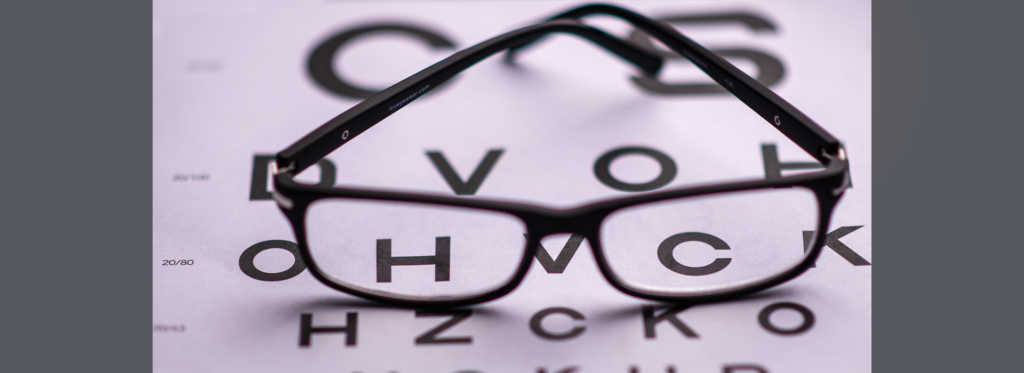
The Driver and Vehicle Licensing Agency (DVLA) states that drivers must have a 6/12 vision as a minimum. Drivers of lorries and larger vehicles must have at least 6/7.5 vision. This is using the Snellen scale for vision. Drivers must be able to read a car number plate from 20M away. This allows them to pass the eyesight segment of their test and drive safely.
The DVLA says that if drivers need glasses to see clearly while driving then they must wear them. Police have the authority to stop and deliver an eye test to anyone who is driving dangerously. Drivers caught without suitable ‘standards of vision for driving’ could face having their license revoked. Other penalties include a £1,000 fine or points on their license.
While it is not a legal requirement for drivers to notify the DVLA if they need glasses since passing their test, a study found that 1 in 3 drivers notify them anyway.
Other health conditions that could affect vision also mean drivers cannot operate larger vehicles. These include anxiety, high blood pressure, and diabetes. Drivers with these conditions should report them before operating large vehicles. Fleet operators have a responsibility to ensure all their drivers are road safe and well before hitting the road.

Useful Links
To apply for a fuel card with us today, click here
To learn more about our selection of fuel cards, click here
Click here to find out more about Cambrian Fuelcard Services
To learn how our telematics solutions will help your fleet become more efficient and effective, click here
You can view the official guidance on the GOV.UK website by following this link.